
The 8 Signs of a Plumbing Leak (and What You Need to Do About Them)
New Jersey is no stranger to old homes and ancient piping systems. When you notice a leak, you need to act as quickly as possible to keep your home safe from mold damage, high energy bills, and even flooding.
Knowing the common signs of a plumbing leak puts you in the best possible spot to get solutions fast. The longer you wait, the higher the risk that your home will develop a massive mold spot or that your foundations will rot from water damage.
The average American household uses 300 gallons of water per day for activities like making food, bathing, watering lawns, and brushing their teeth. That’s over a hundred thousand gallons of water every year. When a leak can use up to 20 gallons per day, you have extra costs and potential water damage on your hands!
Some leak signs are obvious, while others are more subtle. This list will explore the most common ones to get you started.
If you suspect a leak, call a plumber and get it fixed. The solution is long-lasting, and the peace of mind is priceless.
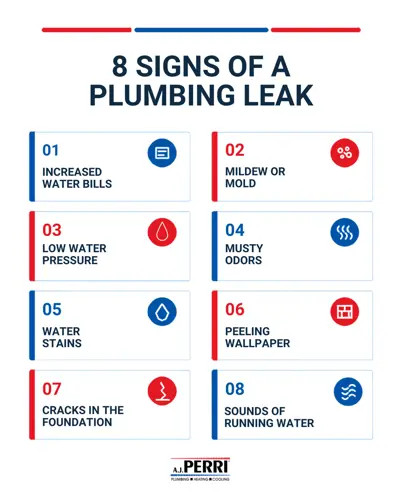
8 SIGNS OF A PLUMBING LEAK
Don’t put your home at risk for high bills and mold outbreaks. With these top eight signs, you’ll have the knowledge needed to spot these plumbing problems earlier and get help faster.
1. INCREASED WATER BILLS
If your water bills have increased unexpectedly while your municipal water rates haven’t changed, this could be due to a leak in your plumbing system. If you can’t visibly see water stains or puddling in odd places, don’t worry—a master plumber has the experience and the tools to pinpoint the hidden leak.
When you call a plumber, they’ll bring a toolkit with items such as infrared cameras and acoustic leak detectors to pinpoint subtle changes in temperature or sound. Before you reach out to a plumber, though, double-check the other signs on this list to see if you have additional leaks to deal with.
2. MILDEW OR MOLD
These culprits are typically found in warm, damp areas of your home. They often signal there could be an interior leak somewhere in your pipe system, gradually building up moisture and allowing the mildew or mold to multiply.
Not only can a professional plumber pinpoint the leak and plug it up, they can also help connect you with mold remediation services to fix the damage already caused.
3. LOW WATER PRESSURE
You likely have an ideal pressure for your shower or kitchen faucet. However, if your faucets have turned from showering to sprinkling, you may have a problem.
One of the most common signs of plumbing leaks is water pressure that fluctuates for no obvious reason. Low water pressure could mean a leak is diverting water from one area to another.
4. MUSTY ODORS
Leaks that go undetected for a while will eventually give off a musty odor. If you’re noticing an odd, musty, mildew-like smell every time you enter your home, it could signal that water is lying hidden somewhere.
5. WATER STAINS
Water stains on the ceiling are typically an indicator that your roof is leaking or that you have an interior plumbing leak. If your home is on the newer side, it’s possible the problem was addressed prior to your move-in, and you simply need to clean the stain.
However, you won’t know for certain until you let a professional do a thorough check. The last thing you want is a water stain creating a massive mold problem that affects your health. Unchecked mold growth is directly linked to irritated sinuses, worsened asthma symptoms, sneezing, and more.
6. PEELING WALLPAPER
Sometimes peeling paint or bubbling wallpaper can mean there is moisture within your walls. While this moisture can come from a leak, it may also point to incompatible materials not mixing together properly.
It’s better to be safe than sorry. If you’ve noticed unexplained paint peeling and falling wallpaper, give our pros a call, and we’ll investigate the issue.
7. CRACKS IN THE FOUNDATION
Houses can experience small cracks as they age. A sudden crack in your drywall or foundation that keeps getting larger can signify a leaky pipe.
Cracked pipes cause all kinds of problems, from leaks to potentially contaminated water. If you notice cracks that keep getting bigger, give us a call.
8. SOUNDS OF RUNNING WATER
Do you hear gurgling or dripping even when you turn the water off? This is a sure sign you have a leak somewhere in your pipes, so your next order of business should be to see if you can patch it up.
Waterproof tape, such as silicone tape, can be used to temporarily patch up a visible leak until you can get help. If the leak is somewhere you can’t reach, though, you’ll need to call a plumber as soon as possible. Water damage can cause mildew, mold, and eventually rot.
WHERE TO LOOK FOR LEAKS
Need a place to start looking for signs of plumbing leaks? Below is a list of common problem areas in most homes:
Visually inspect all pipes in your home for telltale watermarks on walls or ceilings. In the yard, the ground above the water line may stay wet continuously or flow water on the surface.
Do you know how much water can be wasted from what seems like an insignificant drip? Faucets that leak at the rate of one drip per second can waste more than 3,000 gallons of water each year. What may appear to be a minor, annoying leak that you learn to tune out adds up, wasting a precious natural resource while increasing your water bill.
A leaking toilet can waste anywhere from several gallons to more than 100 gallons per day (that’s over 36,500 gallons per year!). Leaking toilets are not as easily identifiable as leaking faucets. The following are clues that you may have a leak:
You have to jiggle the handle to make the toilet stop running.
You regularly hear sounds from a toilet that is not being used.
Your toilet periodically turns the water on for 15 seconds or so without anyone touching the handle.
Even if your toilet does not display any of the above symptoms, it could still be leaking. These silent leaks can go undetected for long periods, potentially wasting thousands of gallons of water every year.
HOW MUCH CAN A DRIPPING FAUCET COST YOU?
If you have a dripping faucet, or you’ve found signs of a hidden plumbing leak behind the wall or a mold spot you can’t get rid of, it’s time to talk about costs. Ignoring these problems won’t make them go away, and they will potentially balloon into a much more expensive problem.
Your dripping faucet can cost you an extra $20 to $30 per month. American homes with leaks waste, on average, more than 10,000 gallons of water every year due to running toilets, dripping faucets, or other household leaks. Homeowners still have to pay for water that is lost through leaking fixtures or pipes, not to mention the energy dollars lost if it is a hot water leak!
HOMEOWNER PLUMBING LEAK PREVENTION CHECKLIST
You don’t have to wait for a leak to happen. With our prevention checklist, you can keep these problems at bay with a proactive attitude and a sharp eye for detail.
KITCHEN
Check under your kitchen sinks once or twice per month to make sure there are no suspicious wet spots or musty smells.
Double-check near any appliances that use water, like the refrigerator water line or the area around your dishwasher.
Keep an eye out for slow-draining water or rotten egg-like odors coming from your drain. These usually point to growing clogs, which can eventually cause a leak if they linger too long.
BATHROOM
Double-check the base of your toilet for potential water damage. You shouldn’t see any puddles or dark spots.
Check your vanities to make sure nothing has spilled without your noticing.
Keep a close eye out for cracked caulk (a breeding ground for mildew and mold).
Look for bubbling paint on the walls or unexplained wet spots in your sink drawers.
LAUNDRY ROOM
Double-check your washer hoses to make sure there are no cracks or nearby dark spots.
Look at the floor for possible puddles or fuzzy spots (which could be mold).
Review your drain line. Call a professional if it’s not immediately accessible.
BASEMENT
Check for possible mold, mildew, or wet spots around exposed pipes or equipment.
Along with looking for damp spots, keep a sharp eye out for any rust or corrosion. These signs may appear like orange or yellow build-up on pipes.
OUTDOORS
Check the area around your hoses, connections, and sprinkler lines for any dark spots. Turn on hoses and sprinklers for a second or two to make sure the water flows smoothly with no sputtering or trickling.
Review the soil further from your house, as leaks can sometimes travel through the piping to make wet spots in your front or back yard.
WHEN TO CALL A PLUMBER
Many leaks just can’t be resolved without a professional hand. They may be too buried within your house for you to reach, or may signal a much deeper problem like tree root intrusions or old pipe systems.
You should call a plumber if you see these signs of a plumbing leak:
You have unexplained water stains that don’t go away.
You can hear running water somewhere, but can’t find the source.
You’ve noticed water dripping near electrical areas (which is a major safety hazard).
You have unexplained water pressure changes.
You’re worried about a mold outbreak from a leak.
These are just a few of the common issues found in plumbing inspections. When in doubt, always call a professional to be on the safe side and keep your home protected from water damage.
FIX YOUR PLUMBING WITH A.J. PERRI
What goes into a professional plumbing inspection? When you work with A.J. Perri, you get access to seasoned plumbers who’ve seen just about everything a home can throw at them.
A.J. Perri has been patching up leaks and keeping homes safe since 1971. With just one call or online form, you get easy access to a local team of expert plumbers who know New Jersey’s plumbing problems firsthand. We bring advanced leak detection tools and a variety of flexible solutions to address problems like cracked pipes, old piping systems, and damaged fixtures.
Don’t put off fixing that leak! We have the services to prevent costly plumbing repairs for homeowners. Let A.J. Perri put this entire frustrating situation behind you with an in-depth inspection that fixes the problem right the first time.
